The traditional Japanese curtain I keep specifying for families who need a boundary, not a building project
A noren room divider is one of the smallest changes I recommend to clients, and one of the most useful. If you haven’t come across the word, a noren is a length of fabric, usually linen, hung in a doorway or across an opening, split with one or more vertical slits so you can walk straight through it. In Japan it traditionally marks the entrance to a shop or divides one room from another. In an open-plan family home, it does something I find myself needing constantly: it draws a line between two spaces without asking you to build a wall to do it.
- Why Tatami Is Not Just a Traditional Japanese Material
- How Scandinavian Hygge and Japanese Wabi-Sabi Merge in Japandi Homes
- What is Japanese Tatami and How to Incorporate it in Your Home
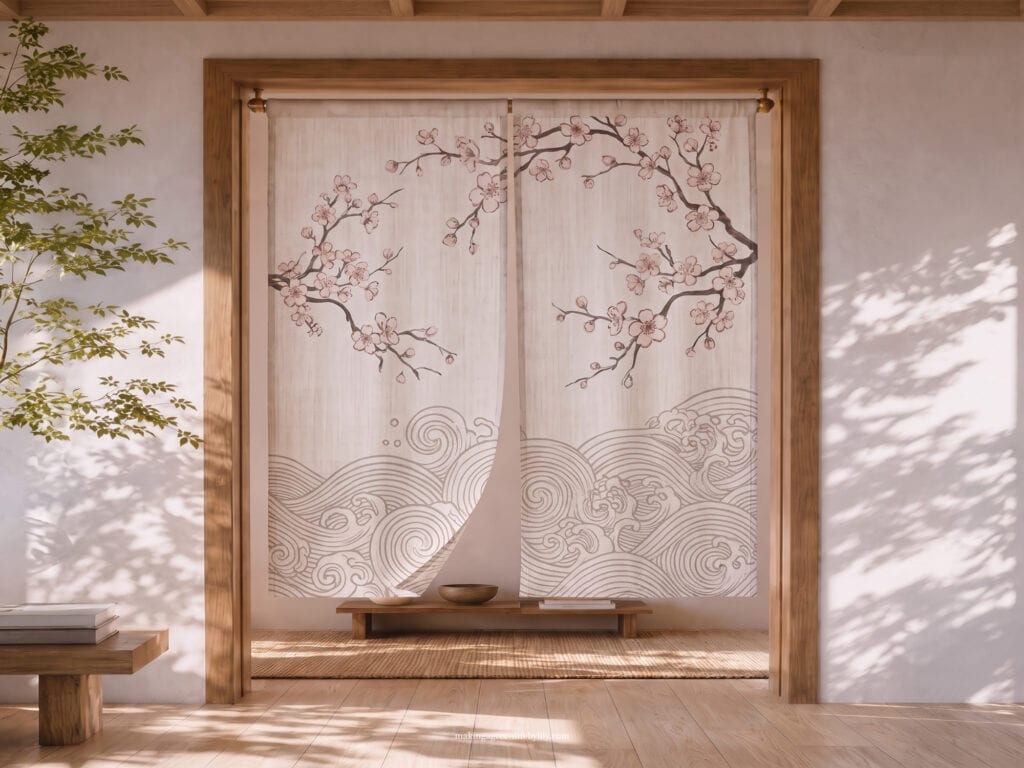
Open-plan living is wonderful until a family actually moves into it. A kitchen that flows straight into a playroom, or a living room that opens onto a home office corner, sounds ideal on a floor plan and turns into constant, low-level chaos in practice, noise travelling everywhere, toys migrating into every zone, no sense of where one activity ends and another begins. A noren room divider is the softest possible answer to that problem, and it’s the one I reach for before anything structural.
Why a noren room divider works better than a wall or bookcase
The obvious fixes for open-plan chaos are a stud wall, a full bookcase, or a folding screen, and I’d avoid all three as a first move. A wall is permanent and expensive, and it usually kills the exact light and flow that made you choose an open-plan layout in the first place. A tall bookcase blocks sound about as well as a wall does, which is to say barely at all, while still cutting off daylight and sightlines. A noren does neither of those things. Light passes straight through the weave. Sound is softened rather than sealed, because the fabric absorbs rather than bounces it, which matters enormously in a room full of children’s noise. And because it’s simply hung rather than built, you can move it, remove it, or reposition it the moment your family’s layout needs change, which in a home with young children happens more often than anyone plans for.
What it does provide is the psychological boundary that open-plan homes actually lack. Walking through a noren to get from the kitchen to the playroom tells your brain, and your child’s, that you’ve entered a different zone, even though nothing has technically been enclosed. That’s a distinction I come back to often in family homes: the marker of a boundary is sometimes more useful than the boundary itself.
Where I actually use them in family homes
The doorway between a kitchen and a playroom is the single most common spot I hang a noren, because it lets a parent hear and half-see what’s happening in the next room while still giving the space its own identity. A study corner carved out of a living room is another strong candidate, where a noren hung from a simple rod marks “work happens here” without needing a partition wall that would make the room feel smaller for everyone else using it. I’ve written before about using wood slat panelling to divide open-concept rooms, which is the more architectural version of the same instinct, and a noren is the version you can introduce in an afternoon rather than a renovation.
They work well in nurseries too, hung across a closet opening instead of a solid door, softening the sightline into a wardrobe of small, chaotic clothing without adding another door to bump into in a tight room. I touch on this kind of soft zoning in my guide to Japandi child-friendly design for nurseries and playrooms, where a lot of the same reasoning applies at a smaller scale.
How to choose and hang one properly
Look for a genuinely mid-weight linen rather than anything sheer or overly stiff. Too light and it reads as a curtain, too heavy and it stops moving with the room, which is part of what makes a noren feel alive rather than static. I favour natural, undyed or naturally dyed tones, indigo, clay, oatmeal, over anything printed, so it sits within a Japandi palette rather than competing with it.
Hang it on a simple tension rod or a slim wooden pole set into the top of the doorway, at a height that clears a tall adult’s head comfortably. The slit or slits should sit roughly where a person naturally walks through, not dead centre for symmetry’s sake if that’s not where the traffic actually flows. And treat it as washable, practical textile rather than precious decor: a noren in a family home will pick up handprints and the occasional crayon mark, and a good midweight linen takes a gentle wash without losing its shape.
Final thoughts on Noren: The Soft Room Divider Solving Open-Plan Family Chaos Without a Wall
A noren room divider won’t solve every open-plan problem, but for the specific chaos of sound, sightlines and children moving between zones that were never meant to be one room, it does more work than most people expect from a single length of fabric. It’s inexpensive, reversible, and entirely in keeping with a Japandi home’s preference for solving problems gently rather than structurally. If your open-plan layout has been bothering you for a while, this is the smallest possible place to start.
If you’d like help thinking through how to zone an open-plan family home properly, softly or otherwise, my e-design service is where I do exactly this kind of room-by-room planning, and I work with families remotely wherever you’re based.
Related Japandi Articles:
Avoid These 7 Mistakes When Trying Japandi Style
11 Creative Ways to Use Wood Slat Panelling in Your Japandi Home
Japandi Child-Friendly Design: Creating Serene Nurseries and Playrooms
7 Thoughtful Ways to Make Your Living Room Feel More Japandi
5 Ways to Optimise Storage in a Japandi Living Room
10 Core Principles I Follow When Designing Japandi Spaces As an Interior Designer
How to Create a Family-Friendly Japandi Home
Slow Living Starts at Home: The Lifestyle Behind Japandi Design
Noren The Soft Room Divider Solving Open-Plan Family Chaos Without a Wall