
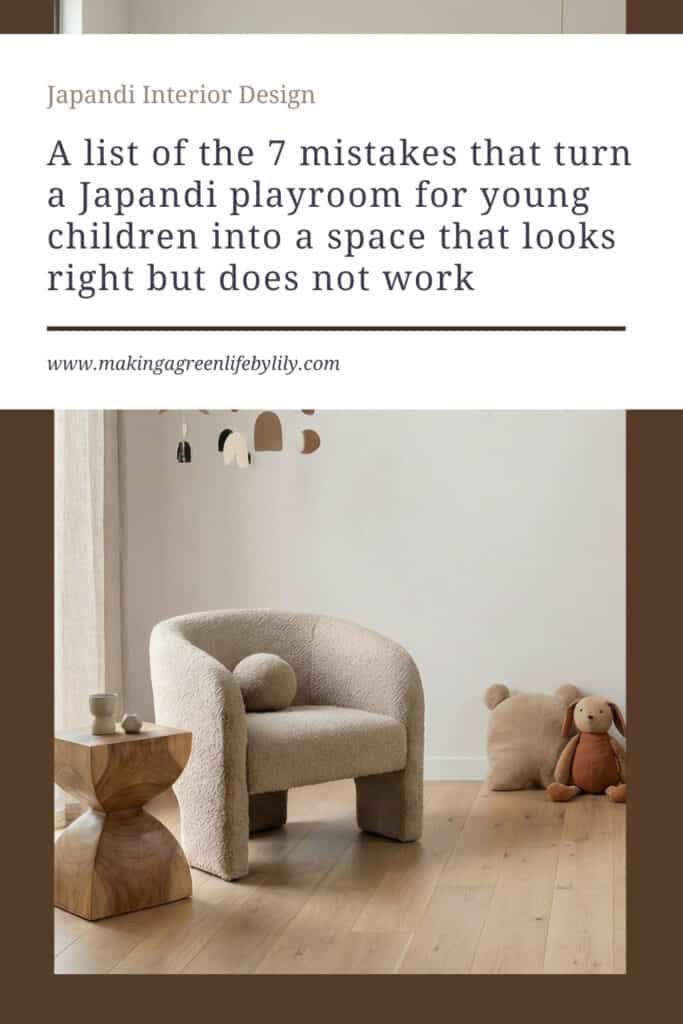
A list of the 7 mistakes that turn a Japandi playroom for young children into a space that looks right but does not work.
The Japandi playroom is having a real moment. I’ve had more enquiries about children’s spaces in the past year than in the several before it combined, and almost all of them arrive with the same picture attached: pale wood, low shelves, a few beautiful wooden toys arranged just so. It’s a lovely idea, and it’s also where most of the trouble starts.
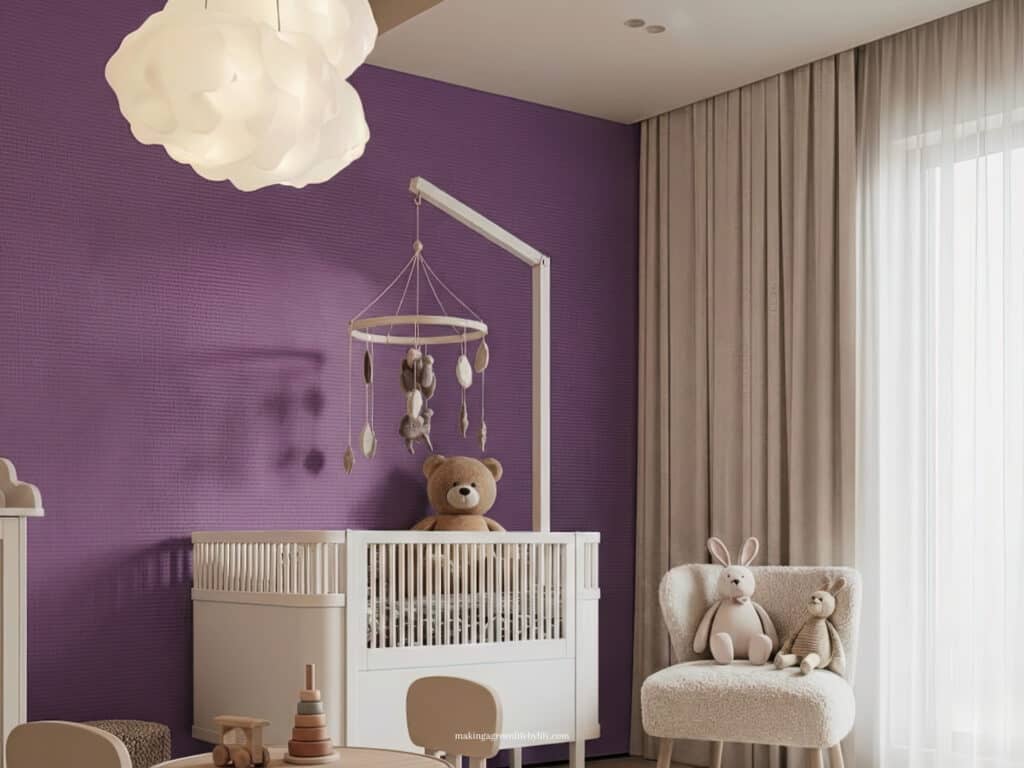
- Tatami in a Home with Children: The Honest Guide to Choosing, Using and Living with Tatami in Kids’ Rooms
- Japandi and Child-Friendly Design: Creating Serene Nurseries and Playrooms
- How To Create Family-Friendly Japandi Home
Because a playroom is not a photograph. It’s a room a very small person actually lives in, sits on, empties out, and fills back up several times a day. The Japandi rooms I love are the ones that hold up to that, not the ones that only work until a two-year-old walks in. Over years of designing family homes, I’ve watched the same handful of mistakes turn a promising Japandi playroom into a space that either looks right and doesn’t function, or functions and doesn’t feel like anything at all.
Here are the 7 I see most, and what I’d do instead.
#1. You style the room from standing height, not from the floor
This is the first thing I check, and the one almost everyone gets wrong. Adults design rooms from their own eye line, roughly five feet up, looking down. A young child experiences the entire room from the floor: the grain of the boards under their knees, the cool of a hard surface in the morning, the underside of a shelf, the exact height at which the light hits.
When you style only for the standing view, you end up with a room that photographs beautifully and feels strangely unwelcoming at the level where it matters. I always spend a few minutes literally sitting on the playroom floor before I finalise anything. From down there you notice what’s missing: something soft to land on, a warm surface underfoot, a sight line that isn’t just chair legs and skirting. Design the bottom two feet of the room with as much care as the shelf displays, because that’s the part your child will know best.
#2. You confuse Japandi with cold minimalism
Japandi is not the absence of things. The most common misread I see is a playroom stripped back to bare white walls, a pale rug, and three toys, presented as calm when it’s actually just empty. Young children need warmth, texture and a little contrast to feel secure. A room with nothing to touch, nothing to catch the eye, and no depth of tone can read as clinical rather than soothing.
The Japanese half of Japandi is where the warmth lives: aged wood, paper, clay, the honesty of natural materials that carry a bit of imperfection. Bring in tonal layers rather than one flat neutral. A deep walnut stool against oatmeal linen, a charcoal cushion, a woven basket gone soft with use. Warmth is what makes a minimalist room feel like a nursery instead of a waiting area. If you want the fuller picture on getting this balance right for children, I go into it in my guide to Japandi child-friendly design for nurseries and playrooms.
#3. You choose storage that looks calm, but the child can’t actually use it
A beautiful closed cabinet with a discreet handle is a wonderful thing in a Japandi living room. In a playroom for a three-year-old, it’s a design that fights the person using it. If a child can’t open it, reach it, or see what’s inside, the toys never go back in, and the calm you designed for collapses into a floor covered in everything by half past four.
The calmest playrooms I’ve designed are the ones where tidying is physically possible for a small person. That means low, open storage at child height: shallow baskets, a single low shelf, a few labelled trays rather than a tall unit of hidden drawers. It looks less “finished” in a photograph, and it works enormously better in life. A Japandi playroom earns its serenity by being usable, not by hiding the mess behind cabinetry the child will never open.
#4. You over-curate and design the child out of the room
There’s a point where intentional tips over into precious. I’ve walked into playrooms so carefully composed, every wooden toy colour-matched, nothing out of place, that there was no room left for the actual child in them. A playroom that can’t absorb a bit of chaos, a drawing taped to the wall, a collection of pebbles on the shelf, isn’t calm. It’s brittle.
This is where wabi-sabi, the acceptance of imperfection at the heart of Japandi, does real work in a family home. Leave space for the child’s own marks on the room. One shelf that’s theirs to arrange badly. A wall where their paintings go up without you flinching. The room should look a little lived in, because a child lives in it. That’s not a compromise on the aesthetic, it’s the point of it.
#5. You forget soft surfaces, so the room is beautiful and unbearably loud
Japandi leans on hard, honest materials: wood floors, plaster walls, clean surfaces. Put a young child in a room made entirely of those, and you get sound. Bare floors and hard walls bounce every shriek, every wooden block dropped from height, every scooter across the boards. The room looks serene and feels like the inside of a drum, and nobody, child or parent, settles in it.
Softness is not a betrayal of the look; it’s what completes it. A natural-fibre rug is the single most effective change: it shortens the sound, warms the floor for all that floor-level play, and adds exactly the texture the scheme wants. I tend towards something like igusa or a dense flat weave for children’s spaces, and I’ve written about how these materials behave with young children in my honest guide to tatami in a home with children. Add a cushion or two and a soft blind, and the room finally sounds as calm as it looks.
#6. You treat the walls as an afterthought
Walls are where I see the most wasted potential in a Japandi playroom. People pour thought into the floor and the furniture, then leave the walls either blank and a bit forlorn, or crowded with mismatched prints and plastic. Both undo the calm. In a small child’s room, the wall is often the largest thing in their field of view when they’re lying on the floor, and it sets the mood of the whole space.
You don’t need much. One considered wall does the work: a soft limewash in a warm clay tone, a single piece of art hung low enough for a child to actually see, a strip of wood panelling that adds rhythm without noise. Restraint reads as intention here. If you want somewhere to start, my post on Japandi bedroom wall inspirations has ideas that translate straight across to a playroom. Decide the wall on purpose, and the rest of the room falls into place around it.
#7. You design for the child they are now, not the one arriving in two years
Young children change faster than any interior can keep up with. The most expensive mistake I see is a playroom styled tightly around a specific age: a toddler’s low table and tiny chairs, activity stations built for this exact moment, everything perfect for the eighteen-month-old and obsolete by the time they’re four.
Japandi’s quiet flexibility is a gift here if you let it be. Choose pieces that can shift roles: a low open shelf that becomes a bookcase, a floor cushion that outlives every phase, a solid wooden stool that will still be useful in a teenager’s room. Buy fewer things, better made, and leave the arrangement loose enough to evolve. A playroom designed to grow stays calm for years, because you’re not fighting the child’s development every six months. For the wider thinking on making a whole home work this way, my guide to creating a family-friendly Japandi home sits nicely alongside this.
Final thoughts on 7 Mistakes to Avoid When Styling a Japandi Playroom for Young Children
None of these mistakes come from bad taste. They come from designing for the idea of a playroom rather than the reality of a child in one. A Japandi playroom works when it’s built from the floor up, warm rather than bare, usable by small hands, soft enough to be quiet, and loose enough to grow. Get those right, and the calm looks after itself, no matter how many wooden blocks end up on the rug by teatime.
If you’d like a room designed around your child and your home specifically, rather than a Pinterest board, my e-design service is there whenever you’re ready. I work remotely with families all over the world, and children’s spaces are some of my favourite briefs to take on.
Related Japandi Articles:
Japandi Child-Friendly Design: Creating Serene Nurseries and Playrooms
How to Create a Family-Friendly Japandi Home
Tatami in a Home with Children: The Honest Guide
Japandi Bedroom Wall Inspirations
5 Tips on Japandi Design for Small Homeowners
Avoid These 7 Mistakes When Trying Japandi Style
The Art of Layering Textures in Japandi Design
5 Ways to Optimise Storage in a Japandi Living Room
The Psychology of Japandi Design: How It Enhances Well-Being
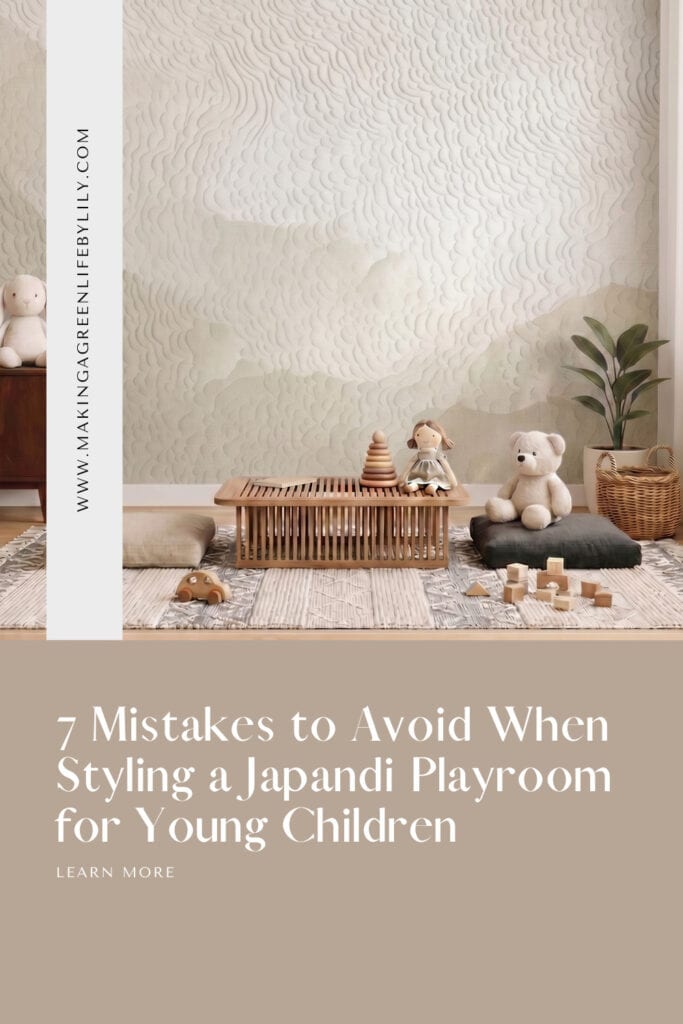
7 Mistakes to Avoid When Styling a Japandi Playroom for Young Children



One Comment