
Everything I’ve learned from specifying natural flooring in family homes, and what I wish more parents asked before they bought
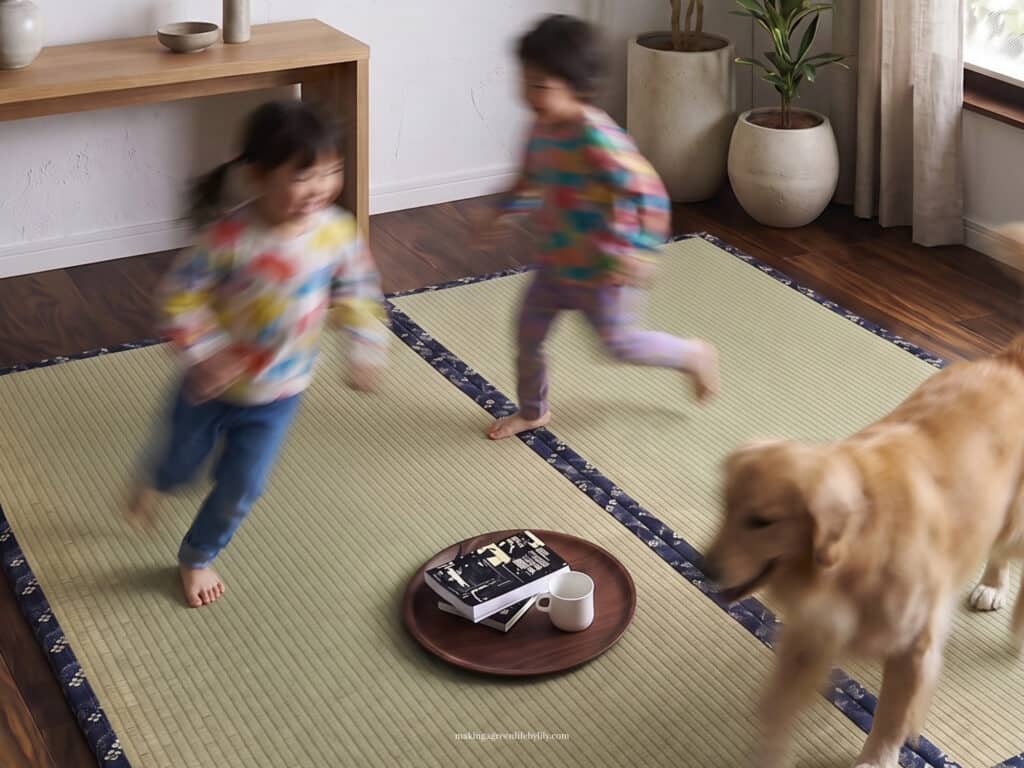
There is a specific kind of worry that comes with designing rooms for families with young children. It’s not about the aesthetic; most parents with a strong design sensibility know exactly what they want. It’s about whether the thing they want will survive contact with their actual lives: the juice spilled on a Tuesday morning, the Lego stored on the floor, the running feet, the dragged chairs, the general and relentless energy of small people in a space.
When the material in question is tatami, made from igusa rush grass, that worry tends to sharpen into a specific question: is this too precious for us? And the answer, which surprises most of the clients I work with, is no. Tatami in kids rooms is not the fragile, ceremonial thing that its traditional Japanese connotations might suggest. It’s a tough, practical, naturally resilient material that was designed, centuries ago, for daily life. The difference is knowing how to use it, what to expect from it, and what it genuinely cannot do.
- Modern Tatami: 7 Ways to Use Tatami Mats in a Japandi Interior Without Going Full Zen Temple
- Igusa, Tatami, and the Quiet Science of Natural Fibres Underfoot
- What Is Tatami, Really? A Designer’s Answer for Modern Homes
This is the guide I give every client before we finalise a Japandi family room with a tatami rug or tatami flooring. It covers the real questions, not the aesthetic ones.
What children actually do to natural fibre floors, and how igusa handles it
The first thing I want to do is set an honest baseline, because parents asking about tatami in kids’ rooms have usually already read the general information about igusa’s durability, and they want to know what it actually looks like in practice.
Children compress, drag, drop, and sit heavily. They eat on the floor. They lie on it. They push toy cars across it. In rooms where floor activity is constant, the rug or flooring material takes a different kind of wear than it would in an adult living room. The question isn’t whether it’s durable in the abstract. It’s whether igusa holds up to this specific use pattern.
Igusa is a rush grass, and the fibres are dense and tightly woven. The surface of a tatami mat is not a loose pile or a lofty weave that catches and pulls. It’s flat and directional, which means compression and surface movement don’t damage it the way they would a wool pile or a hand-knotted rug. A child sitting and spinning on igusa will leave no mark. Dragging a toy box across it may shift it slightly if it’s a rug rather than bonded flooring, but it won’t shred or fray the surface. The robustness of igusa is structural, not just a marketing claim, and it comes from the density of the weave rather than from any treatment or coating.
What igusa does not handle well is sustained, heavy moisture sitting on the surface. A spill that’s cleaned up promptly, within a minute or two, is fine. A wet towel left on a tatami rug for an hour is not. This is the most important thing to know when using tatami in kids’ rooms, and I’ll come back to it with practical guidance below.
The spill question: what actually happens and how to respond
If you have children, you will have spills on your tatami rug. This is not a reason to avoid the material; it’s a reason to understand it and to have a clear response in place.
When something liquid lands on igusa, the surface doesn’t immediately saturate the way a pile rug does. Igusa has a natural moisture management quality, meaning it absorbs slowly and releases slowly. This gives you a small but useful window. If you blot the spill immediately with a clean, dry cloth, pressing down firmly rather than rubbing, you’ll lift most of the moisture before it penetrates the weave. For water or pale liquids, this is usually enough. The surface may look slightly darker in the wet spot for a few minutes, then return to its normal colour as it dries.
For anything more pigmented, juice, tomato sauce, coloured yoghurt, the approach is the same: blot immediately, press firmly, do not rub. Once you’ve removed as much moisture as possible, allow the area to dry completely before checking whether a mark remains. If it does, a very slightly damp cloth with a tiny amount of rice bran soap, worked gently along the grain of the weave, will usually address it. Never use anything acidic or strongly alkaline on igusa. Vinegar, which many people reach for as a natural cleaner, can damage the fibres and accelerate yellowing.
The rule of thumb I give clients is simple: respond to spills within sixty seconds, and the igusa will almost certainly be fine. Leave it, and you’ll be dealing with a more stubborn situation. In practical terms, this means tatami in kids rooms requires a slightly different level of attentiveness than carpet, where the pile absorbs and hides everything until it becomes a problem later. Igusa asks you to act immediately, but it rewards that response.
Choosing the right placement in a child’s room
Not every spot in a child’s room is equally appropriate for tatami, and the placement decisions I make when specifying it for family projects follow a clear logic.
Tatami works well as a centred rug in a play area, a reading corner, or the zone in front of a low bed. It does not work as a rug that sits under a dining table or craft area where glue, paint, or food are being used habitually, because those activities create repeated, varied marks that are harder to manage than occasional spills.
In a child’s bedroom, the ideal placement is either as a full floor covering (which is how tatami was originally used in Japan, where beds were brought to the floor rather than raised) or as a centred rug in the play and movement zone of the room. A low bed platform surrounded by tatami creates exactly the calm, settled quality that Japandi family rooms are designed for. The floor becomes part of the rest, the play, the reading. Children are often drawn to tatami’s particular texture underfoot, especially barefoot, because it has a slight resistance that pile doesn’t offer and a coolness in warmer months that feels pleasant.
Keep tatami away from radiators and direct heat sources. Igusa needs a degree of ambient humidity to stay supple. A very dry environment, particularly in rooms with underfloor heating running constantly or a radiator directly adjacent, can cause igusa to become brittle over time. I usually suggest keeping windows cracked occasionally in rooms with tatami, especially in autumn and winter, because moderate humidity is what igusa prefers. This is actually good practice for children’s bedrooms generally, which tend toward the too-warm.
The sensory dimension: what igusa gives children that other natural fibres don’t
This is the section most guides skip, but I think it’s one of the more meaningful reasons to choose tatami for a child’s space specifically.
Igusa has a scent. It’s mild and grassy, faintly sweet in the way a hay meadow is sweet, and it’s most noticeable when the tatami is new or has been warmed slightly by sunlight through a window. The scent fades over time as the igusa settles, but a trace of it remains, particularly in small, enclosed spaces like a child’s bedroom. In Japan, this scent is considered part of the material’s value. It’s one of the things people mean when they talk about the atmosphere of a tatami room.
For children, this matters in a way that’s harder to quantify but easy to observe. A room with a distinctive, calm scent feels different from a room without one. It becomes associated with certain activities, rest, play, reading. There’s a growing body of research on the relationship between natural scents and children’s stress responses, and igusa specifically has been studied in Japan for its mild anxiolytic effects. I’m not making a medical claim here, only observing that many parents in homes I’ve worked on note, unprompted, that their child’s room with tatami feels calmer, that their children settle more readily in it. The scent is part of this, alongside the texture and the visual quietness of the material.
The tactile quality of igusa underfoot is also worth mentioning. It’s firm, slightly resistant, and cool. Barefoot on igusa feels different from barefoot on wool or jute. There’s a quality to it that’s grounding in the most literal sense: children who spend time playing on the floor are experiencing a specific, natural texture that has a long history of being associated with rest and care. I think this matters, even if it’s difficult to put numbers to it.
How tatami ages in a family room, and what to expect over time
One of the things I always tell parents is that tatami doesn’t really decline, it transitions. New igusa is pale, slightly green, with a strong scent. Over the course of six months to a year of normal use, it begins to shift toward a warm honey gold. The scent softens. The surface develops a very slight patina, not worn-looking but settled-looking, the way good oak or leather looks after a few years of use.
In a family room, this aging process is part of the material’s character. The tatami that’s been lived with, that’s been the floor of a child’s play space for two or three years, doesn’t look tired. It looks like it belongs. The honey gold tone works beautifully with Japandi palettes because it sits in exactly the warm neutral range that works with oak, linen, ceramic, and pale-washed wall colours.
What changes over a much longer period, and this is honest disclosure, is that igusa will eventually need to be replaced if it’s used as full flooring rather than a rug. Traditional Japanese tatami mats were turned, re-covered with fresh igusa, and eventually replaced as a matter of course. A tatami rug, because it’s a smaller area and takes less intense use, will have a longer useful life. But the ageing is genuine and part of the material’s story, not a defect.
What I’d tell any parent before they buy
If you’re choosing tatami for a room where children live and play, these are the practical points I’d want you to have before you commit.
Act on spills immediately. The sixty-second rule is real and it matters. Keep the area slightly ventilated and away from strong direct heat. Vacuum with the grain of the weave, not across it, once a week. Avoid steam cleaning, which drives moisture deep into the igusa. If you’re using a tatami rug rather than full tatami flooring, lift and air it occasionally to prevent any moisture accumulating underneath. And let yourself enjoy the fact that this material, unlike wool, unlike jute, will not look worse for having children in the room. It will age honestly, the way all the best natural materials do.
If you’d like to see the tatami rug I’ve designed for homes like this, including how it’s constructed and why I chose the dimensions I did, you’ll find it at japandibymaglbl.com.
For more on how the tatami rug compares to other natural options, my post on tatami vs traditional rugs lays out the comparison in detail. And if you’re still at the “what exactly is tatami?” stage, my designer’s answer to that question is a good place to start.
Final thoughts on Tatami in a Home with Children: The Honest Guide to Choosing, Using and Living with Tatami in Kids’ Rooms
Tatami in kids’ rooms is not a compromise. It’s not the choice you make because it looks good in photographs, and then quietly regret when daily life arrives. It’s a material with centuries of history in rooms where people actually lived, slept, sat on the floor, and made the full range of mess that daily life involves. The question is not whether igusa can handle children. It can. The question is whether you know enough about it to use it well, and I hope this guide has answered that.
If you’re designing a Japandi family home from the ground up, or rethinking a child’s room that isn’t working, this is a material worth serious consideration. It’s honest, it’s natural, it’s tough in the ways that matter, and it makes a room feel like itself.
Related Japandi Articles:
- What a Japandi Rug Actually Does for a Room
- Modern Tatami: 7 Ways to Use Tatami Mats in a Japandi Interior Without Going Full Zen Temple
- 5 Benefits of Using a Tatami Rug in Your Home
- Tatami vs Traditional Rugs: The Side-by-Side
- Igusa, Tatami, and the Quiet Science of Natural Fibres Underfoot
- The Wellness Benefits of Igusa You Probably Didn’t Know
- Japandi and Child-Friendly Design: Creating Serene Nurseries and Playrooms
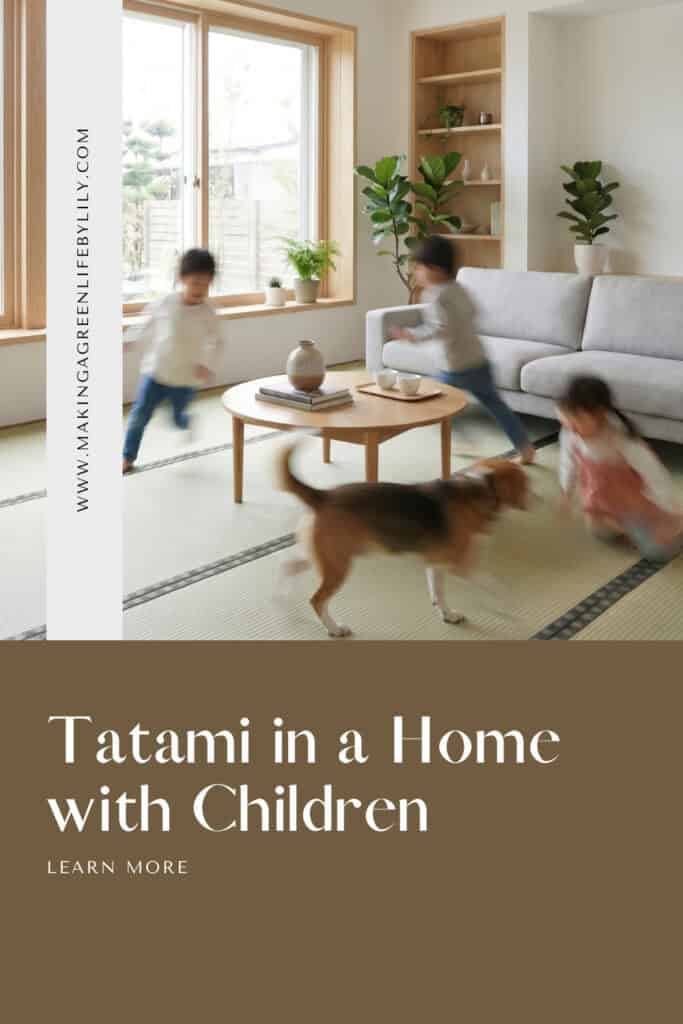
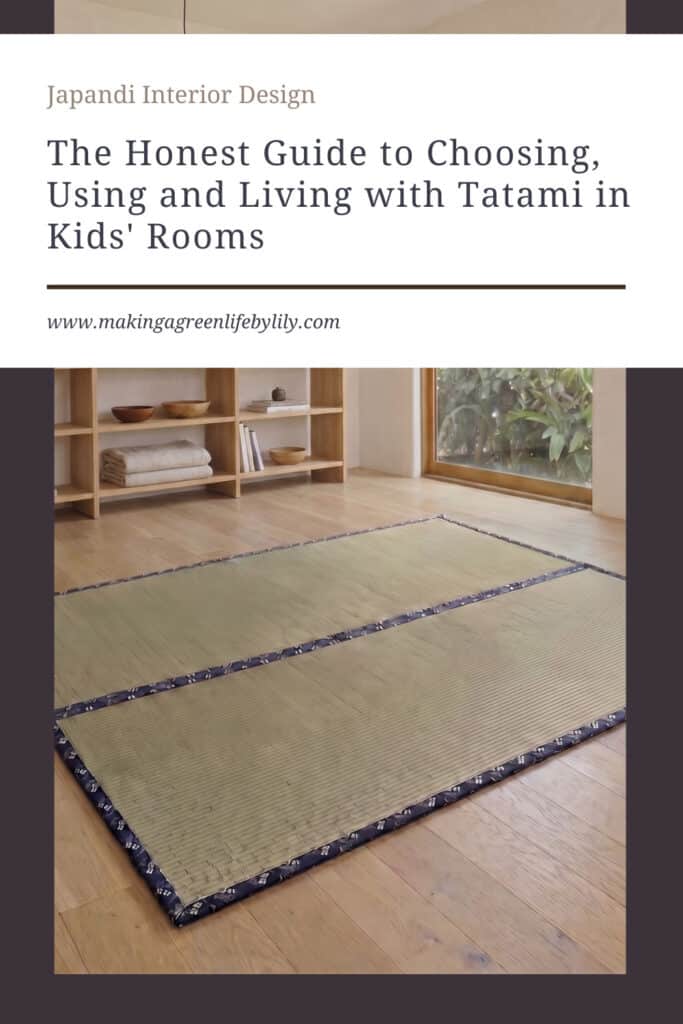
Tatami in a Home with Children: The Honest Guide to Choosing, Using and Living with Tatami in Kids’ Rooms


2 Comments