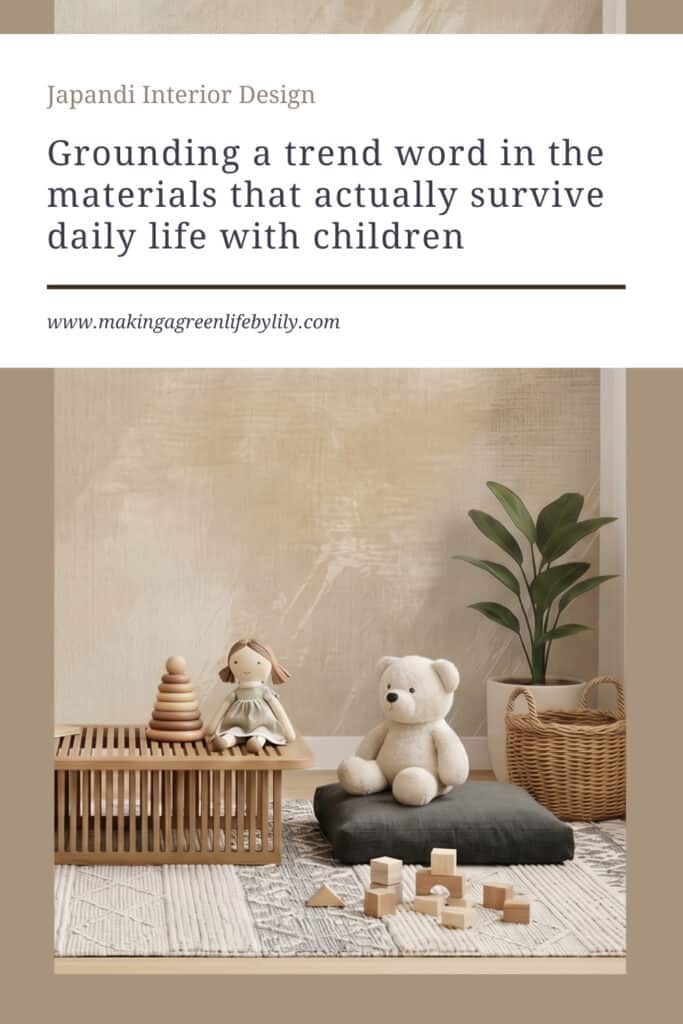
Grounding a trend word in the materials that actually survive daily life with children
“Quiet luxury” has been everywhere for the past couple of years, and by now it’s mostly a mood board phrase: a beige linen sofa, a single olive branch in a stone vase, a kitchen with nothing on the counters. It photographs beautifully. It also has almost nothing to do with how a quiet luxury family home actually needs to work once real children are living in it, dropping things, spilling things, and testing every surface within reach.
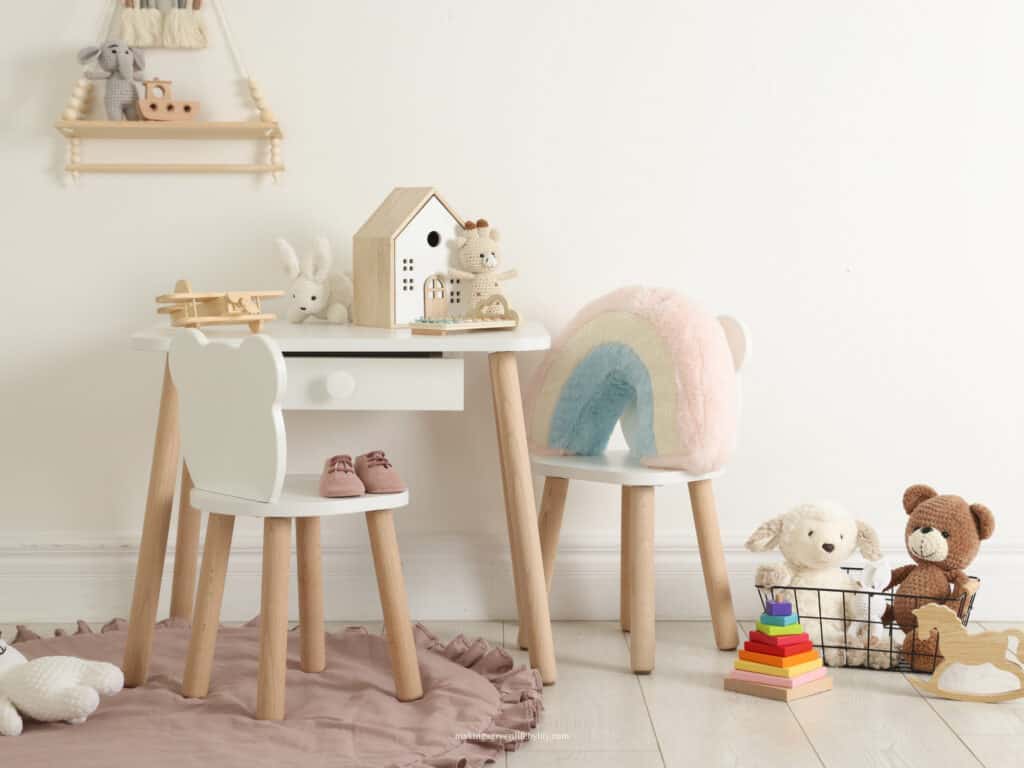
I design Japandi homes for families with young children, and quiet luxury is a phrase I hear a lot from new clients now, usually as a kind of shorthand for “I want it to feel expensive without looking flashy.” I understand the instinct completely. But the version they’ve seen online, the one styled for a single adult in a serene, static room, falls apart within a week of a toddler moving through it. What I’ve learned from years of specifying materials for family homes is that quiet luxury was never really about restraint for its own sake. It’s about choosing things good enough that they don’t need to be protected from the life happening around them.
- Tatami in a Home with Children: The Honest Guide to Choosing, Using and Living with Tatami in Kids’ Rooms
- 7 Mistakes to Avoid When Styling a Japandi Playroom for Young Children
- Japandi and Child-Friendly Design: Creating Serene Nurseries and Playrooms
This post is my honest answer to what quiet luxury actually means when there’s a nine-year-old’s football kit by the door, and a Lego set mid-construction on the coffee table, because that’s the home I’m actually designing for, and I suspect it’s the one you’re living in too.
What a quiet luxury family home actually means
Strip away the styling and quiet luxury is a fairly simple idea: value that shows itself through quality and longevity rather than logos, shine, or obvious expense. In a family home, I’d take that one step further. A genuinely quiet luxury family home is one where the good materials are the ones doing the daily work, not the ones kept out of reach on a shelf.
That distinction matters because the most common misunderstanding I see, and one I’ve written about at length in my piece on the mistakes people make trying Japandi style, is treating quiet as the same thing as empty. A room with almost nothing in it isn’t quiet luxury; it’s just under-furnished, and it tends to feel cold and slightly anxious rather than calm. Real quiet luxury has warmth and weight to it. It’s a wide oak dining table that’s clearly seen ten years of homework and birthday cake. It’s a boiled wool throw that’s been washed enough times to go properly soft. The luxury isn’t in the absence of use. It’s in materials substantial enough that use doesn’t diminish them.
The materials that carry quiet luxury through family life
If I had to name the single thing that separates a quiet luxury family home from one that’s simply expensive and fragile, it’s material choice, and specifically choosing materials whose whole life cycle includes children living on top of them.
Solid wood is the obvious starting point. A dent in a veneered chipboard table looks like damage. A dent in a solid oak or walnut table looks like a mark of time, because the material has enough integrity underneath to absorb it without the finish splitting or the structure weakening. The same logic applies to stone and ceramic surfaces over anything laminated, and to natural stoneware over thin porcelain that chips at the first knock.
Textiles matter just as much, and this is where I see clients get caught out most often, usually by buying pale, delicate linen because it looks right in a photograph and then living in fear of it for two years. I steer family clients towards heavier, tightly woven linens and cottons, boiled wool, and canvas with a bit of body to it. These fabrics resist pilling, wash well, and actually improve with the kind of wear a family sofa gets, softening rather than thinning. Leather is worth mentioning too: a good full-grain leather with a natural, slightly matte finish takes scuffs as character rather than damage, which is precisely the opposite of what happens to a shiny, bonded leather substitute.
I go into the reasoning behind these choices more broadly in my ten core principles for designing Japandi spaces, but the family-specific version of the principle is straightforward: buy the material that’s designed, by its own nature, to survive contact with a child, rather than the one that merely photographs as though it could.
Why polish is the wrong goal in a home with children
Somewhere in the quiet luxury conversation, polish and calm got confused with each other, and I think that confusion causes more anxiety in family homes than almost anything else I encounter. Clients show me reference images of pristine, untouched rooms and ask how to keep their own home looking like that with three children under ten in it. My honest answer is that they can’t, and more importantly, they shouldn’t want to.
I worked with a family last year whose living room had a low, wide oak coffee table exactly built for the kind of tea-ring and felt-tip incidents that arrive with young children. The mother apologised for it within about thirty seconds of me walking in, gesturing at a faint water mark near one corner. I told her what I tell every client in that position: the table looks like a family lives there, and that is the room working exactly as intended. A surface that shows nothing after two years with children in the house usually means it was too precious to actually be used, which defeats the purpose of choosing it at all.
This is wabi-sabi doing its quiet, practical work, the acceptance that wear, marks and small imperfections are part of an object’s honest life rather than a failure of care. A quiet luxury family home isn’t one that resists evidence of the family living in it. It’s one built from materials that carry that evidence gracefully, so the marks read as patina rather than damage.
Where quiet luxury actually holds up in a family home
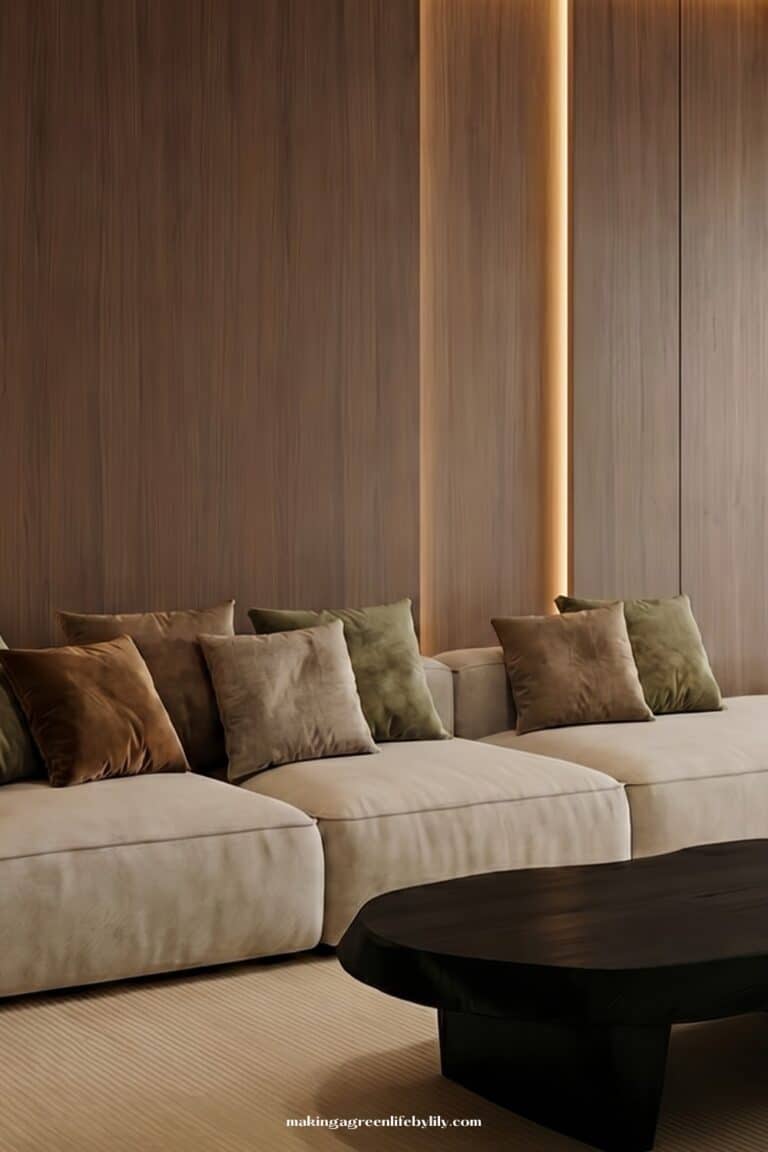
It’s easiest to see how this plays out room by room. In the entryway, that means a solid wood bench with an oiled rather than lacquered finish, so scuffed shoes and dropped school bags don’t leave a mark that sits on top of the surface rather than into it. In the living room, it means choosing upholstery in a performance-grade natural weave rather than a delicate one, and a rug in a dense, forgiving fibre that hides the daily traffic rather than showing every footprint.
Kitchens do particularly well with honed rather than polished stone, because a matte finish simply doesn’t show the scratches and water spots that a high-gloss surface broadcasts immediately. And in bedrooms and shared family spaces, I lean on solid wood furniture with rounded, worn-in edges over anything sharp, new, or veneered, because it’s both safer for small hands and visibly more at ease with time.
None of this requires a full renovation to introduce. I’ve written more broadly about building a whole home around this thinking in my guide to creating a family-friendly Japandi home, and the short version holds true here too: you don’t need to redo every room at once. Start with the piece your family touches most: the sofa, the dining table, the entryway surface, and let that set the standard the rest of the room grows towards.
The one shift that makes the biggest difference
If you take one thing from this, let it be this: buy fewer things, and buy them in materials built to age rather than to stay new. That single shift does more for a genuinely quiet luxury family home than any amount of careful styling, because it removes the constant, low-level tension of protecting things that were never meant to withstand daily family life in the first place.
A home full of solid, honest materials settles into itself over years in a way that a home full of delicate, photograph-ready pieces never quite manages. The trainers by the door and the Lego on the table aren’t obstacles to that calm. They’re simply what a lived-in, well-made family home actually looks like, and that, to me, is the real definition of quiet luxury.
Final thoughts on What Quiet Luxury Actually Means in a Family Home With Muddy Trainers and Lego Underfoot
Quiet luxury was never meant to describe an empty room kept safe from a family’s actual life. It describes materials good enough, and honest enough, to carry that life without complaint: wood that takes a dent well, linen that softens with washing, leather that scuffs into character rather than damage. Choose those pieces once, properly, and the calm you’re after stops being something you protect and becomes something the room simply has.
If you’d like help choosing those pieces for your own home, rather than guessing from a mood board, my e-design service is built exactly for this kind of thinking. I work remotely with families all over the world, and durable, quietly luxurious materials are at the centre of almost every plan I put together.
Related Japandi Articles:
- Avoid These 7 Mistakes When Trying Japandi Style
- How to Create a Family-Friendly Japandi Home
- 10 Core Principles I Follow When Designing Japandi Spaces As an Interior Designer
- Japandi Child-Friendly Design: Creating Serene Nurseries and Playrooms
- 5 Elements of Japandi
- Slow Living Starts at Home: The Lifestyle Behind Japandi Design
- 5 Ways to Optimise Storage in a Japandi Living Room
- 7 Thoughtful Ways to Make Your Living Room Feel More Japandi
- Tatami in a Home with Children: The Honest Guide
- 7 Mistakes to Avoid When Styling a Japandi Playroom for Young Children
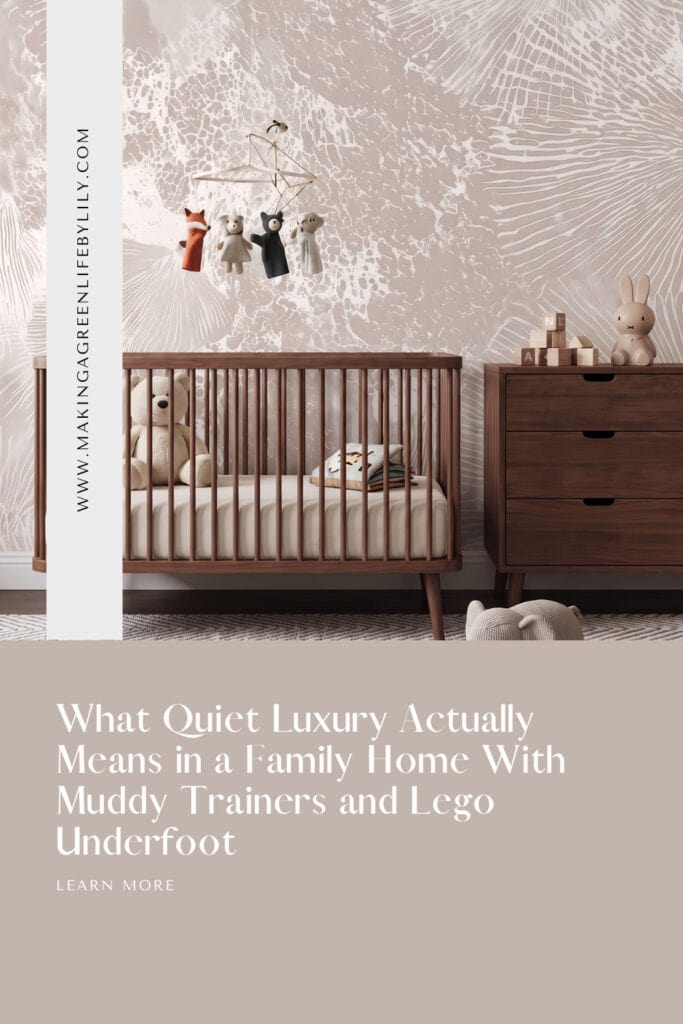
What Quiet Luxury Actually Means in a Family Home With Muddy Trainers and Lego Underfoot f

One Comment