A family-functional comparison for anyone choosing a japandi style rug
A few years ago, I spent a lot of time trying to find the right japandi style rug for a client’s living room. The family had two young children, a pale oak floor, and a clear brief: natural material, calm, something that would last. I went through wool options, jute samples, a couple of cotton flatweaves, and nothing quite sat right.

- Modern Tatami: 7 Ways to Use Tatami Mats in a Japandi Interior Without Going Full Zen Temple
- Why Tatami Is Not Just a Traditional Japanese Material
- 5 Benefits of Using a Tatami Rug in Your Home
I knew I wanted igusa. I just didn’t have a product I could point to with confidence.
That experience is part of why I’m making a tatami rug now. But it’s also what makes me want to lay out this comparison properly, because the differences aren’t obvious until you’re living with them.
What we’re actually comparing
This post is about choosing between tatami, made from igusa rush grass, and the more familiar natural and conventional rug options: wool, jute, cotton, and synthetic fibres. I’m framing it through the lens of a Japandi home with real daily use, because that’s the context I work in most often.
I’m not suggesting one rug type is right for every home. I am suggesting that for a japandi style rug in a family home that values natural materials, honest ageing, and low maintenance, tatami makes a case that the others don’t quite match.
Natural fibre vs synthetic: the choice most people get wrong first
Synthetic rugs, polypropylene, viscose, and their variations, are often positioned as the practical choice. Easy to clean, affordable, available in almost any colour or pattern. In a Japandi room they tend to look fine and feel slightly wrong. There’s a flatness to them, a lack of depth in texture, and a quality that’s difficult to name but easy to sense: they don’t belong.
Beyond the aesthetic, there are the material questions. Synthetic rugs shed microplastics. Some off-gas in warm rooms, particularly lower-cost viscose. For anyone building a home around natural materials and non-toxic rugs, this matters. It’s one of the reasons I don’t recommend synthetic fibres in Japandi rooms, and why I spend the extra time with clients to find the right natural option.
The natural fibre category is where most of the interesting decisions happen.
How tatami compares to wool, jute, and cotton
Wool is the most obvious natural fibre alternative, and it has real merits. It’s warm, it’s resilient, it can be beautiful. The problem in a Japandi context is maintenance. Wool pills. It requires specialist cleaning. In a family home, a wool rug in a pale or mid-tone colour (the tones that work in Japandi rooms) takes active care to keep looking good. There’s also the softness question: some clients want a softer rug underfoot than igusa offers, and for those clients wool can be the right answer. But for most, the maintenance trade-off makes it harder to live with than it looks in the shop.
Jute is the natural fibre rug most people start with because it’s accessible and relatively affordable. It photographs well and has the right earthy tone for a Japandi room. The reality is that jute can feel rough underfoot, particularly for bare feet, and it doesn’t age as gracefully as igusa. It’s also more vulnerable to moisture than igusa, which is counterintuitive but true: jute fibres can rot if they stay damp, while igusa, with its natural moisture management properties, handles humidity better.
Cotton flatweaves are the practical choice. They’re washable, easy to live with, and inexpensive to replace. In a Japandi room they can work well in the short term, but they lack the sensory depth of a natural fibre rug made from something more substantial. They feel thin. They don’t add anything to the room acoustically or atmospherically, and the honest ones tend to look worn quite quickly.
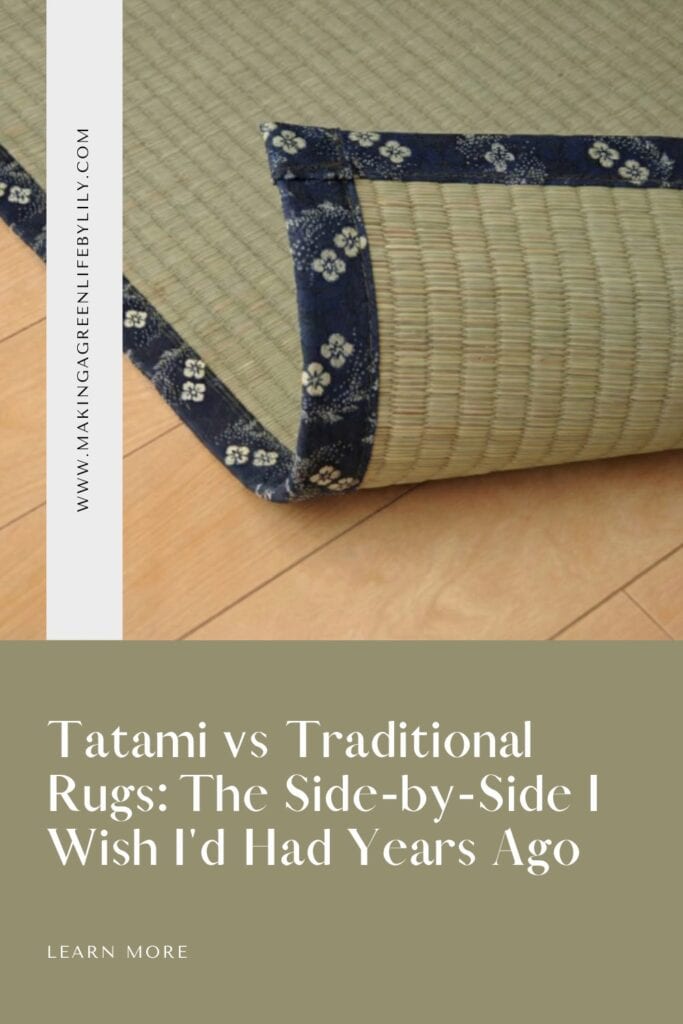
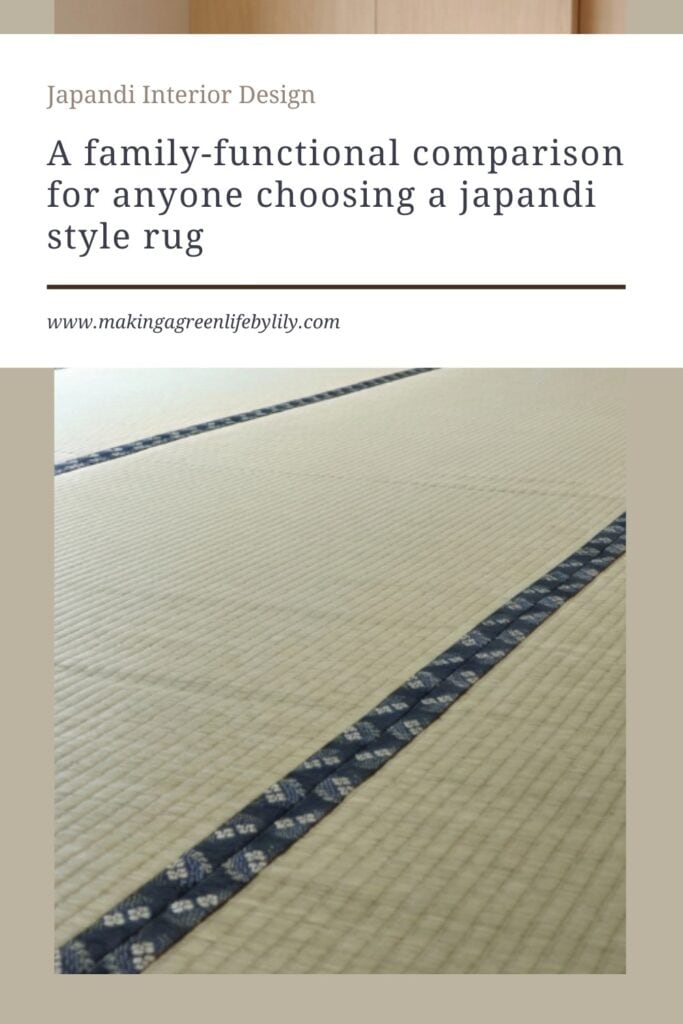
Tatami, by comparison, offers things the others don’t: a specific scent, a directional weave that interacts with light, acoustic softening, and the particular underfoot quality of igusa. It also ages differently. Rather than declining, it shifts from a warm pale green to a mellow honey gold over time. A room looks more settled with it after a year than it did on day one.
The sustainable rug question
Sustainable rugs are a category that gets muddier the closer you look. “Natural” doesn’t always mean low-impact. Wool requires significant water and land resources. Jute is often shipped long distances and may be treated with chemicals before it reaches you. Cotton, depending on how it’s grown, can be one of the most resource-intensive agricultural crops in the world.
Igusa is a fast-growing plant that requires relatively little input compared to many alternatives. It’s grown in Japan under conditions that have developed over centuries, without the industrial processing required by synthetic fibres. It’s not a perfect material in every environmental dimension, no material is, but in the category of non-toxic rugs made from natural fibres, it competes well.
For clients who come to me specifically asking about sustainable interior design materials, igusa is always part of the conversation. It’s not a compromise choice or a niche one. It’s a practical, long-lasting option with a genuinely natural origin.
My verdict for family homes
If you’re choosing a japandi style rug for a room where the floor gets real daily use, where there are children or pets or both, and where you want something that will look better in three years than it does today, the comparison leads me to the same place every time.
Tatami, made from real igusa, is the most honest choice. It’s robust, it’s natural, it ages in rather than down, and it contributes to the room in ways that go beyond what it looks like. It asks for less care than wool. It feels better underfoot than jute. It has more presence than cotton.
The only reason I haven’t been recommending it with a direct product link until now is that the right product didn’t exist. That’s what I’m making.
If you’d like to join the newsletter for the tatami rug when it launches, you can do that at japandibymaglbl.com. And if the wider room decision is what you’re working through, my post on what a japandi rug actually does for a room is a good place to start. There’s also more on igusa specifically in my material guide to the quiet science of natural fibres underfoot.
Related Japandi Articles:
- 10 Unexpected Ways to Use Wallpaper in a Japandi Home
- How To Create Family-Friendly Japandi Home
- The Role of Negative Space in Japandi Design: A Scientific Perspective
Tatami vs Traditional Rugs: The Side-by-Side I Wish I’d Had Years Ago